
.png?width=1440&height=622&name=Accounting%20Service%20Menu%20Image%20(1).png)
.png?width=1440&height=622&name=Tech%20Service%20Menu%20Image%20(1).png)
.png?width=1440&height=622&name=Financial%20Serivce%20Menu%20Image%20(1).png)
.png?width=1440&height=622&name=M%26A%20Service%20Menu%20Image%20(1).png)
.png?width=1440&height=622&name=Talent%20Service%20Menu%20Image%20(1).png)
%20(1).jpg?width=264&height=160&name=Website%20Featured%20Content%20Images%20(2)%20(1).jpg)
%20(1).jpg?width=264&height=160&name=Website%20Featured%20Content%20Images%20(4)%20(1).jpg)
-Mar-08-2024-08-50-35-9527-PM.png?width=300&height=175&name=Untitled%20design%20(1)-Mar-08-2024-08-50-35-9527-PM.png)

%20(1)-1.jpg?width=264&height=160&name=Website%20Featured%20Content%20Images%20(2)%20(1)-1.jpg)
-1.jpg?width=264&height=160&name=Website%20Featured%20Content%20Images%20(1)-1.jpg)
%20(1).jpg?width=264&height=160&name=Website%20Featured%20Content%20Images%20(3)%20(1).jpg)


.jpg)

%20(1)-2.jpg)
When business owners hear “exit planning,” many immediately think about selling their company. But in most cases, exit readiness starts long before a transaction is even on the horizon. It starts with building a business that can operate successfully without depending entirely on the owner. That shift in mindset is often the foundation of a stronger company overall, whether the goal is to sell, transition ownership internally, or simply create more long-term stability.
Exit Planning is Really About Building a Transferable Business
Many owners spend years growing a business around themselves. They become the lead decision-maker, key relationship holder, operational problem solver, and internal expert all at once. While that approach may help a business grow early on, it can create challenges later.
A common question in exit planning is: "Could the business continue operating successfully if you stepped away for an extended period of time?"
If the answer is unclear, that usually signals opportunities to strengthen the business structure, processes, or leadership team. Buyers and successors are not just evaluating revenue and profitability. They are evaluating how sustainable the business is without the current owner at the center of everything.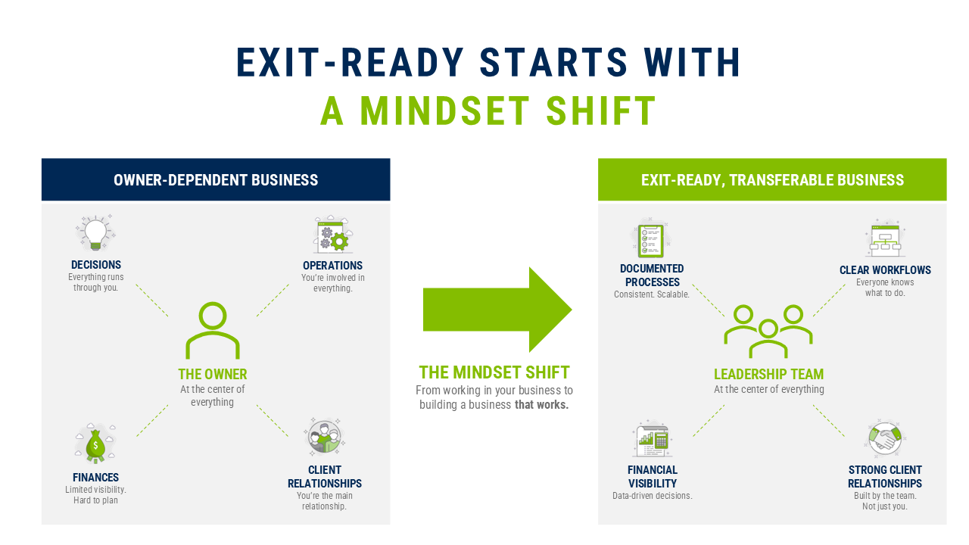
What do all successful business transitions have in common?
Strong exits are rarely created through last-minute preparation. More often, they are the result of gradual operational and financial improvements made over time. Businesses that are better positioned for transition typically have:
- Consistent financial reporting
- Clearly documented operational processes
- Leadership responsibilities spread across a team
- Reliable internal systems and workflows
- Reduced dependency on one individual
- Are responsibilities clearly documented?
- Can financial and operational information be accessed easily?
- Do employees understand processes without relying on one person for answers?
These characteristics do more than support a future sale. They often improve efficiency, decision-making, and scalability in the present as well. That is why exit planning can benefit owners even if they have no immediate plans to transition the business.
What is the importance of operational processes?
In closely held businesses, important knowledge often lives with the owner or a few key employees. That may work internally, but it can create risk during a transition. For example:
- Are responsibilities clearly documented?
- Can financial and operational information be accessed easily?
- Do employees understand processes without relying on one person for answers?
When workflows and systems are organized, businesses are typically easier to manage, scale, and transition. This also becomes especially important during due diligence. Buyers often want to understand how the business functions operationally, not just financially.
Financial Visibility Matters
Clean financial reporting is one of the most important parts of exit readiness. Financial statements that are accurate and consistent help support credibility throughout the process. On the other hand, financials that require significant cleanup or explanation can slow momentum and raise concerns. Owners do not need to overhaul everything at once. Even incremental improvements can strengthen long-term value over time.
Prepare for What’s Next with Lutz
Whether you are planning a future transition or simply looking to build a stronger business, preparing early can make a significant difference. Lutz M&A services help you evaluate the financial, operational, and strategic areas that support long-term business value and exit readiness. Contact us to learn more.

- Analytical, Achiever, Context, Competition, Learner
Ryan McGregor
Ryan McGregor, Consulting Director at Lutz M&A, began his career in 2012. With a diverse background in banking and finance, he has developed extensive expertise in business valuation, mergers and acquisitions, and exit planning.
Specializing in succession planning and valuations, Ryan focuses on helping clients across various industries including agribusiness, construction, healthcare, and manufacturing. He conducts in-depth market analysis and prepares comprehensive valuation reports for purposes ranging from gift and estate planning to Small Business Administration (SBA) qualified opinions. Ryan values building relationships with clients and finds satisfaction in seeing them successfully transition their businesses through well-crafted succession plans.
At Lutz, Ryan has demonstrated his commitment to professional expertise, earning multiple designations including Certified Exit Planning Advisor (CEPA), Certified Valuation Analyst (CVA), and Certified Mergers & Acquisition Advisor (CM&AA). His analytical approach and drive for continuous learning enable him to provide innovative solutions tailored to each client's unique needs.
Ryan lives in Omaha, NE, with his wife Beth and their three children. He enjoys spending time with his large family and is an avid golfer and sports fan.
Recent News & Insights

The Market Is Harder to Outsmart Than It Looks

Tailoring QuickBooks Online to Fit Your Nonprofit’s Needs

The Great Wealth Transfer: Retaining the Next Generation

Lutz adds Phothisane and Rolf