
.png?width=1440&height=622&name=Accounting%20Service%20Menu%20Image%20(1).png)
.png?width=1440&height=622&name=Tech%20Service%20Menu%20Image%20(1).png)
.png?width=1440&height=622&name=Financial%20Serivce%20Menu%20Image%20(1).png)
.png?width=1440&height=622&name=M%26A%20Service%20Menu%20Image%20(1).png)
.png?width=1440&height=622&name=Talent%20Service%20Menu%20Image%20(1).png)
%20(1).jpg?width=264&height=160&name=Website%20Featured%20Content%20Images%20(2)%20(1).jpg)
%20(1).jpg?width=264&height=160&name=Website%20Featured%20Content%20Images%20(4)%20(1).jpg)
-Mar-08-2024-08-50-35-9527-PM.png?width=300&height=175&name=Untitled%20design%20(1)-Mar-08-2024-08-50-35-9527-PM.png)

%20(1)-1.jpg?width=264&height=160&name=Website%20Featured%20Content%20Images%20(2)%20(1)-1.jpg)
-1.jpg?width=264&height=160&name=Website%20Featured%20Content%20Images%20(1)-1.jpg)
%20(1).jpg?width=264&height=160&name=Website%20Featured%20Content%20Images%20(3)%20(1).jpg)


.jpg)

Paul Baumert and Julianne Kipple

Rural hospitals continue to face mounting financial pressure. Rising labor costs, workforce shortages, reimbursement changes, aging infrastructure, and growing technology demands make it harder each year to stay financially stable while serving the community.
Even with limited resources, many organizations still have opportunities to strengthen how revenue and expenses are managed. The biggest gains rarely come from major strategic overhauls; they come from operational and reimbursement improvements that already sit within reach, often overlooked while leadership focuses elsewhere.
This article breaks down five areas where rural hospitals can find that kind of impact: cost controls and operations, Medicare cost reports, grants and funding, strategic planning, and reimbursement optimization. Evaluating each one regularly, rather than waiting for a financial crisis to force the issue, is what positions an organization for long-term success.
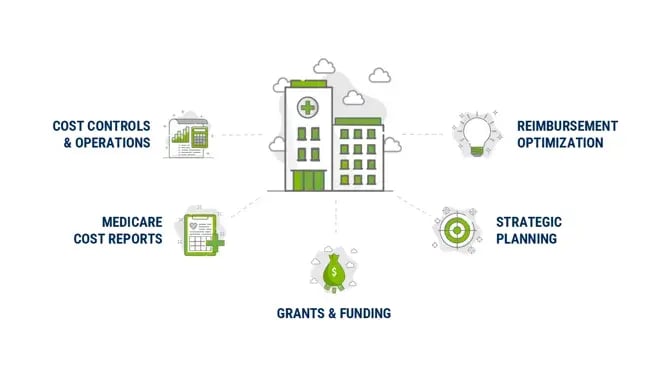
1. Cost Controls & Operations: Look for Profitability Leaks Before Cutting Services
When margins tighten, organizations often begin evaluating service reductions or staffing cuts. While those decisions may sometimes be necessary, they shouldn't be the starting point. In many cases, opportunities can be found within existing processes and controls.
Areas worth reviewing include:
- Purchasing approval procedures
- Vendor management practices
- Contract oversight
- Segregation of duties
Hospitals should also regularly compare budget-to-actual results by department and investigate unusual variances rather than treating them as routine fluctuations. Staffing costs often deserve closer attention. Overtime, contract labor, and duplicate service agreements can quietly erode margins. At the same time, recruitment and retention efforts remain critical, as reducing dependence on contract labor often produces some of the most significant long-term savings.
The goal isn't simply to cut expenses. It's to ensure resources are being used effectively and aligned with organizational priorities.
2. Medicare Cost Reports: Treat It as a Strategic Tool
Many organizations view the Medicare cost report primarily as a compliance requirement. It can also serve as an important reimbursement optimization tool.
Small reporting errors, outdated allocation methodologies, or inaccurate statistics can impact reimbursement outcomes. Revenue and expenses should be carefully matched, departmental allocations should be reviewed regularly, and statistical data should be evaluated for accuracy.
Hospitals should also periodically assess whether their allocation methodologies still make sense. For example, changes in facility layout, staffing, technology usage, or service delivery models may warrant updates to existing allocation approaches.
Additional review areas may include:
- Rural Health Clinic and provider-based clinic structures
- Time studies and contract allocations
- New construction projects and related cost centers
- Non-allowable costs
- Service lines that are not reimbursed on a cost basis
A detailed cost report review often uncovers opportunities that would otherwise go unnoticed.
3. Grants & Funding: Don’t Overlook Available Opportunities
Many rural hospitals are focused on controlling costs, but improving financial performance also requires maximizing available funding opportunities. Recent initiatives have created significant funding opportunities for rural providers. Programs such as the Rural Health Transformation Program (RHTP), Rural Hospital Stabilization Program, HRSA grant opportunities, workforce loan repayment programs, and USDA funding initiatives are designed specifically to strengthen rural healthcare delivery.
Dealing with funding shortages and navigating available programs can both be challenging. Hospitals that take a proactive approach by monitoring funding opportunities, collaborating with state agencies and community partners, and incorporating grant strategy into long-term planning are often better positioned to secure resources that support operational and strategic objectives.
4. Strategic Planning: Connect Financial Planning to Long-Term Strategy
Strong financial performance doesn't come from an annual budgeting exercise alone. The most successful rural hospitals align budgeting, forecasting, and strategic planning efforts to create a clearer picture of where the organization is headed and how resources should be allocated.
That starts with developing budgets that reflect expected patient volumes, staffing needs, and revenue drivers. It also means evaluating upcoming reimbursement changes, identifying gaps in community healthcare services, and assessing opportunities for service line growth.
Technology planning now plays a larger role. Organizations must balance investments in cybersecurity, automation, revenue cycle optimization, and infrastructure modernization while maintaining financial stability.
Workforce planning is equally critical. Recruitment, retention, training, and leadership development all play a direct role in an organization's long-term financial health.
Rather than treating these initiatives as separate conversations, leading organizations integrate them into a unified strategic planning process.
5. Reimbursement Optimization: Capture Every Available Opportunity
Reimbursement optimization remains one of the most overlooked areas of financial improvement. Many rural facilities qualify for reimbursement programs or payment methodologies that are underutilized or not regularly reviewed.
Examples may include:
- Medicaid Disproportionate Share Hospital (DSH) payments
- Method II billing opportunities
- CRNA pass-through reimbursement
- Ambulance reimbursement enhancements
- State Medicaid Directed Payment Programs
As reimbursement models continue to evolve, organizations should regularly evaluate whether they are maximizing every available revenue opportunity. This is particularly important given anticipated changes to Medicaid funding and directed payment programs in the coming years. Hospitals that understand how those changes may affect future revenue streams can make more informed financial and operational decisions today.
A periodic reimbursement review can help organizations identify missed opportunities while ensuring compliance with program requirements.
How Lutz Supports Rural Hospitals
For rural hospitals, the greatest opportunities may already exist within current operations. A thorough review of cost reports, reimbursement programs, internal controls, service lines, and funding opportunities can uncover improvements that strengthen both financial performance and long-term sustainability.
At Lutz, our professionals work together to identify opportunities for rural healthcare organizations to improve financial performance so they can continue serving their communities. If you’d like help reviewing or developing a long-term financial strategy, contact us to start a conversation.
To hear Lutz experts discuss this topic further, you can view our webinar.

- Relator, Achiever, Restorative, Focus, Belief
Paul Baumert
Healthcare Consulting Shareholder
Paul Baumert, Healthcare Consulting Shareholder, began his career in 1998. With over two decades of experience, he has established himself as a pivotal leader in healthcare accounting and consulting. Since 2011, Paul has led Lutz’s rural hospital practice, showcasing his commitment to serving healthcare organizations.
Specializing in Medicare and Medicaid reimbursement, cost reporting, and financial analysis, Paul leverages his extensive experience to provide solutions that generate positive financial results for hospitals. His day-to-day responsibilities encompass financial management support services and reimbursement analysis. Paul finds fulfillment in helping rural healthcare facilities maintain their critical role in their communities.
At Lutz, Paul embodies the firm's commitment to serving beyond expectations through his dedication to rural healthcare sustainability. His ability to restore financial health while maintaining meticulous attention to detail has solidified Lutz's position as a trusted advisor to healthcare organizations across the region. As department head, he has cultivated a team that shares his passion for preserving and enhancing rural healthcare access.
Paul lives in Elkhorn, NE, with his wife Shelly, their four children, dog Max, and cats Luna and Oliver. Outside the office, he reads, plays golf, and attends his children’s activities.

- Achiever, Learner, Strategic, Context, Individualization
Julianne Kipple
Healthcare Shareholder
Julianne Kipple, Healthcare Shareholder, began her career in 2008. Over the years, she has built a strong expertise in healthcare accounting and consulting while driving the expansion of Lutz’s services for rural and critical access hospitals. She is actively involved in the healthcare department’s operations, focusing on strategic growth and team development.
Leveraging her experience in healthcare finance, Julianne focuses on providing outsourced CFO services to healthcare facilities. She provides Medicare and Medicaid cost reporting, software conversion assistance, and comprehensive financial management solutions. Julianne values ensuring the sustainability of rural healthcare facilities, understanding their vital role in their communities.
At Lutz, Julianne demonstrates what it means to serve beyond expectations by helping healthcare organizations facing complex challenges. Her genuine care for rural healthcare facilities shows in everything she does - from anticipating their needs to finding creative solutions that ensure their success. Through her thoughtful mentorship of her team, she's helped establish Lutz as a trusted partner in the healthcare sector.
Julianne lives in Bennington, NE, with her husband and four children. Outside the office, she can be found attending her kids' sporting events, running, and cooking on the weekends.
Recent News & Insights

Market Commentary
The Market Is Harder to Outsmart Than It Looks
If you are looking for a reason to make a change to your portfolio, today’s market provides ...

Nonprofit
Tailoring QuickBooks Online to Fit Your Nonprofit’s Needs
For nonprofit organizations, every dollar matters. At the same time, accurate financial ...

Family Office
The Great Wealth Transfer: Retaining the Next Generation
Most families with substantial wealth already have the documents. They likely have a will, ...

Recent News
Lutz adds Phothisane and Rolf
Lutz, a Nebraska-based business solutions firm, recently added Sackey Phothisane and MaKayla ...


Let’s get you where you want to go.
We work to simplify complexities, help make critical business decisions, and confidently focus on the things that are truly important to you. We embrace your business as our own to spark the right solutions and help you thrive.