
.png?width=1440&height=622&name=Accounting%20Service%20Menu%20Image%20(1).png)
.png?width=1440&height=622&name=Tech%20Service%20Menu%20Image%20(1).png)
.png?width=1440&height=622&name=Financial%20Serivce%20Menu%20Image%20(1).png)
.png?width=1440&height=622&name=M%26A%20Service%20Menu%20Image%20(1).png)
.png?width=1440&height=622&name=Talent%20Service%20Menu%20Image%20(1).png)
%20(1).jpg?width=264&height=160&name=Website%20Featured%20Content%20Images%20(2)%20(1).jpg)
%20(1).jpg?width=264&height=160&name=Website%20Featured%20Content%20Images%20(4)%20(1).jpg)
-Mar-08-2024-08-50-35-9527-PM.png?width=300&height=175&name=Untitled%20design%20(1)-Mar-08-2024-08-50-35-9527-PM.png)

%20(1)-1.jpg?width=264&height=160&name=Website%20Featured%20Content%20Images%20(2)%20(1)-1.jpg)
-1.jpg?width=264&height=160&name=Website%20Featured%20Content%20Images%20(1)-1.jpg)
%20(1).jpg?width=264&height=160&name=Website%20Featured%20Content%20Images%20(3)%20(1).jpg)


.jpg)


Payroll has become much more automated over the last decade. While the automation has made the process easier and removed much of the manual calculations, payroll mistakes are still common, and they can create compliance issues, penalties, and a significant amount of rework.
The reality is that payroll software only processes the information it's given. If an employee is assigned to the wrong state, compensation is entered incorrectly, or payroll taxes aren't handled properly, the software won't recognize the problem. It will simply process payroll based on the setup provided. As a result, many payroll issues stem from process gaps rather than technology failures.
What Payroll Mistakes Do Businesses Make Most Often?
While every organization is different, the payroll issues we see most often tend to fall into seven categories. Reviewing these areas can help you identify weaknesses in your payroll process before they turn into compliance issues, payroll corrections, or unnecessary administrative work.
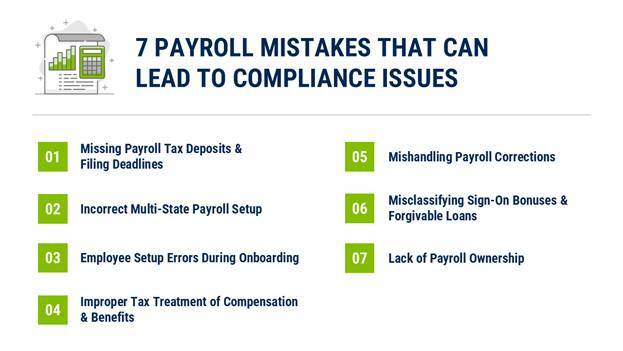
1. Missing Payroll Tax Deposits & Filing Deadlines
One of the most common and costly payroll mistakes is failing to make payroll tax deposits on time. Businesses that process payroll internally are responsible for understanding their deposit schedule, filing requirements, and reporting deadlines.
Missing a deadline can lead to penalties and interest that are entirely avoidable. While many payroll providers handle tax deposits automatically, organizations managing payroll in-house need a process to ensure deadlines are monitored consistently.
2. Incorrect Multi-State Payroll Setup
As remote and hybrid work have become more common, payroll compliance has become more complicated. Many states have different withholding rules, unemployment tax requirements, and reporting obligations. One of the issues we see most frequently is employees being assigned to the wrong state for withholding and/or unemployment purposes. Those mistakes often aren't discovered until a notice arrives, or a filing needs to be corrected.
Businesses can reduce this risk by verifying employee work locations during onboarding, reviewing tax withholding whenever an employee relocates, maintaining an updated list of state tax registrations and periodically auditing employee records to confirm state coding remains accurate.
3. Employee Setup Errors During Onboarding
When employee information isn't collected or entered correctly during onboarding, errors can follow them throughout their time with the organization. Tax withholding elections, direct deposit information, benefits elections, and state tax requirements should all be reviewed during the onboarding process.
Creating a standardized onboarding checklist helps ensure every employee is set up consistently before their first payroll. Having a second person review tax elections and payroll information can also catch errors before they become recurring problems.
4. Improper Tax Treatment of Compensation & Benefits
One area that frequently creates issues is deferred compensation. Contributions to certain nonqualified deferred compensation plans are generally subject to Social Security and Medicare taxes when the compensation vests, even though federal and state income taxes may not be withheld until the compensation is paid. Because different payroll taxes apply at different points in time, setting up deferred compensation incorrectly can create compliance issues and require businesses to revisit prior payroll filings.
5. Mishandling Payroll Corrections
Most payrolls run smoothly when everything follows the normal process. Problems typically appear when exceptions occur.
Voiding and reissuing paychecks, retroactive pay adjustments, or correcting prior payroll periods can create unexpected tax reporting issues if they aren't handled properly. What seems like a simple correction can become more complicated when payroll periods or tax reporting requirements are involved. Having documented procedures for payroll corrections, and knowing when additional review is needed, helps ensure these situations are handled consistently and reported correctly.
6. Misclassifying Sign-On Bonuses & Forgivable Loans
Some businesses overlook the payroll implications of compensation arrangements that don't look like traditional wages. Sign-on bonuses and forgivable loans are common examples. Because these payments aren't part of an employee's regular paycheck, they're sometimes excluded from taxable wages or handled inconsistently.
In most cases, however, sign-on bonuses and forgivable loans represent compensation to the employee at time of payment, even if the employee has not met the qualifications to earn or have the compensation forgiven. Payments under these agreements should generally be treated as taxable wages when made. That means they are typically subject to federal and state income tax withholding, Social Security and Medicare taxes, and should be reported on the employee's Form W-2 in the year the money was paid. Misclassifying these payments can result in payroll corrections, amended filings, and potential penalties.
7. Lack of Payroll Ownership
One of the most important characteristics of a well-run payroll function is having a person who understands how the process works from beginning to end. That includes onboarding employees, understanding benefit taxability, monitoring payroll tax deadlines, and ensuring filings are completed correctly. Without clear ownership, small issues can compound over time and become much more difficult to fix.
Improve Your Payroll Accuracy with Lutz
Payroll software has made processing easier, but technology alone can't prevent mistakes. Most payroll issues stem from incorrect setup, misunderstood tax requirements, or a lack of oversight. As businesses grow, add employees in new states, or introduce new compensation and benefit programs, payroll becomes more complex. This makes regular reviews of your process increasingly important.
If you're evaluating your payroll processes or looking for additional support, Lutz’s Client Advisory Services can help you develop efficient workflows, strengthen internal controls, and navigate payroll compliance challenges. Contact us to start a conversation.

- Individualization, Strategic, Self-Assurance, Positivity, Analytical
Scott Miller
Scott Miller, Client Advisory Services Director, began his career in 2002. He has spent over two decades at Lutz and currently leads the Client Advisory Services division, shaping the department's strategic direction and growth.
Leveraging his extensive experience, Scott focuses on providing business coaching and support across various industries, including construction, healthcare, manufacturing, and restaurants. He specializes in accounting procedures assessments, compensation consulting, and general business advisory services. Scott values helping clients and employees achieve success through thoughtful, tailored guidance and strategic planning.
At Lutz, Scott’s strategic mindset and analytical approach allow him to address each client’s unique challenges, delivering practical solutions that support their growth. His ability to recognize individual strengths and foster a positive environment has been key in building one of the firm’s largest service divisions.
Scott lives in Omaha, NE, with his wife Angela and their five children: Brayden, Allison, Emily, Braxton, and Bryant. Outside the office, he can be found cheering on Creighton volleyball and basketball, following UNK Loper athletics, coaching his kids' sports teams, and running.
Recent News & Insights

The Market Is Harder to Outsmart Than It Looks

Tailoring QuickBooks Online to Fit Your Nonprofit’s Needs

The Great Wealth Transfer: Retaining the Next Generation

Lutz adds Phothisane and Rolf