
.png?width=1440&height=622&name=Accounting%20Service%20Menu%20Image%20(1).png)
.png?width=1440&height=622&name=Tech%20Service%20Menu%20Image%20(1).png)
.png?width=1440&height=622&name=Financial%20Serivce%20Menu%20Image%20(1).png)
.png?width=1440&height=622&name=M%26A%20Service%20Menu%20Image%20(1).png)
.png?width=1440&height=622&name=Talent%20Service%20Menu%20Image%20(1).png)
%20(1).jpg?width=264&height=160&name=Website%20Featured%20Content%20Images%20(2)%20(1).jpg)
%20(1).jpg?width=264&height=160&name=Website%20Featured%20Content%20Images%20(4)%20(1).jpg)
-Mar-08-2024-08-50-35-9527-PM.png?width=300&height=175&name=Untitled%20design%20(1)-Mar-08-2024-08-50-35-9527-PM.png)

%20(1)-1.jpg?width=264&height=160&name=Website%20Featured%20Content%20Images%20(2)%20(1)-1.jpg)
-1.jpg?width=264&height=160&name=Website%20Featured%20Content%20Images%20(1)-1.jpg)
%20(1).jpg?width=264&height=160&name=Website%20Featured%20Content%20Images%20(3)%20(1).jpg)


.jpg)


%20(1)-1.png)
For much of the past decade, large U.S. companies have dominated headlines and portfolios alike. During this period, a handful of mega-cap technology stocks have driven a significant portion of overall market returns. In an environment like this, it is natural to wonder whether smaller companies still matter today.
History suggests they do.
Over long periods of time, small-company stocks have delivered higher returns than their large-company counterparts. The difference has not been dramatic in any single year, but over time, the small advantage can compound into something meaningful. The chart below illustrates the historical size premium, showing how small caps have outperformed large caps across extended time horizons.
Long-Term Outperformance of Small Caps Around the World
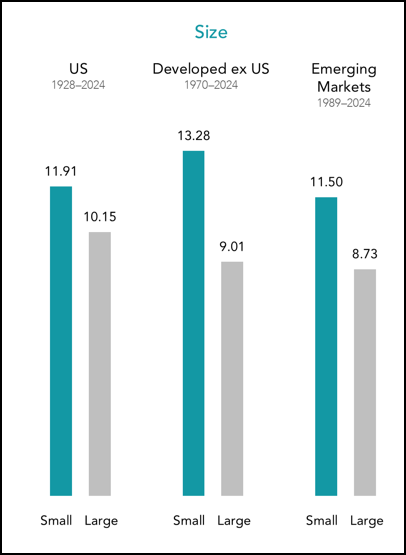
Source: Dimensional Fund Advisors. Bars are represented by the following indices, in order: Dimensional US Small Cap Index, S&P 500 Index, Dimensional International Small Cap Index, MSCI World Ex USA Index (gross div), Dimensional Emerging Markets Small Index, MSCI Emerging Markets Index (gross div).
This outperformance is not the result of speculation or short-term momentum. It is rooted in the simple reality that today’s industry leaders were once small, growing businesses. Companies like Nvidia, Amazon, and Apple did not begin as mega-cap giants. Investors who own smaller companies increase their odds of participating in the next generation of market leaders.
In addition to improving expected returns, small caps also help solve a growing challenge in today’s market: concentration. The ten largest stocks in the S&P 500 now account for more than a third of the entire index, which is unusually high by historical standards. When portfolios are dominated by a few names, performance can swing more sharply if those companies stumble. Adding small companies broadens exposure across industries, business models, and sources of return.
Importantly, the story may already be starting to shift. After a long stretch of large-cap dominance, market performance has begun to broaden, with smaller companies showing signs of renewed strength. While there is no guarantee this will continue, history shows that leadership in markets tends to rotate rather than remain concentrated forever.
Valuations are another important consideration. Large U.S. stocks are currently trading at elevated price-to-earnings ratios. Said another way, investors are paying more for each dollar of earnings than they have historically. Small caps, by contrast, are priced much closer to long-run norms. This does not mean small caps will outperform tomorrow, but research consistently shows that starting valuations matter over the long run. Paying a more reasonable price for earnings has historically led to higher returns over time.
We don’t know which companies will lead the next decade. What we do know is that market leadership changes. By maintaining exposure to small companies alongside large ones, investors avoid overcommitting to the past and remain positioned for the future. That balance has mattered before, and it likely will again.
Week in Review
- The initial reading for fourth-quarter GDP, released on February 20th, indicated that the U.S. economy grew at an annualized rate of 1.4%. Growth was restrained in part by the federal government shutdown, which resulted in a notable pullback in government spending. For full-year 2025, the economy expanded by 2.2%, marking the fifth consecutive year of growth above 2%, a pace generally viewed as consistent with long-term average growth.
- Data released last Friday showed that December Core PCE, the Federal Reserve’s preferred inflation measure that strips out food and energy costs, rose 0.4% on a monthly basis and 3.0% on a yearly basis. PCE, which includes food and energy costs, rose 2.9% on a yearly basis in December.
- According to FactSet, 74% of the S&P 500 reported Q4 results as of February 13th. The earnings growth rate, blended between companies that have already reported and the estimates for those that have yet to report, now stands at 13.2%, which would mark the fifth-straight quarter of double-digit earnings growth reported by the index. FactSet also noted that the blended year-over-year revenue growth for the S&P 500 is currently at 9%, which would mark the highest revenue growth rate since Q3 2022.
Hot Reads
Markets
- Why Tariffs Aren’t Shrinking the U.S. Trade Deficit (WSJ)
- Here Are (Some) Answers to Your Biggest Tariff Questions (WSJ)
- Fourth-Quarter U.S. GDP up just 1.4%, badly missing estimate; inflation firms at 3% (CNBC)
Investing
- Endowment Lessons – What Investors Can Learn from the University of Chicago’s recent budget challenges (HumbleDollar)
- Early Mortgage Payments or Invest in the Stock Market? (Ben Carlson)
- Corporations Are Winning the Stock Market. Here’s a New Plan for Everyone Else (Larry Swedroe)
Other
- Michael Pollan’s Best Advice for Eating Healthier Food – 60 Minutes (YouTube)
- The Trick to Finally Clear Your Hips in the Golf Swing (YouTube)
- Full Overtime: USA Sinks Canada for 1st Olympic Gold Since 1980 – NBC (YouTube)
Markets at a Glance
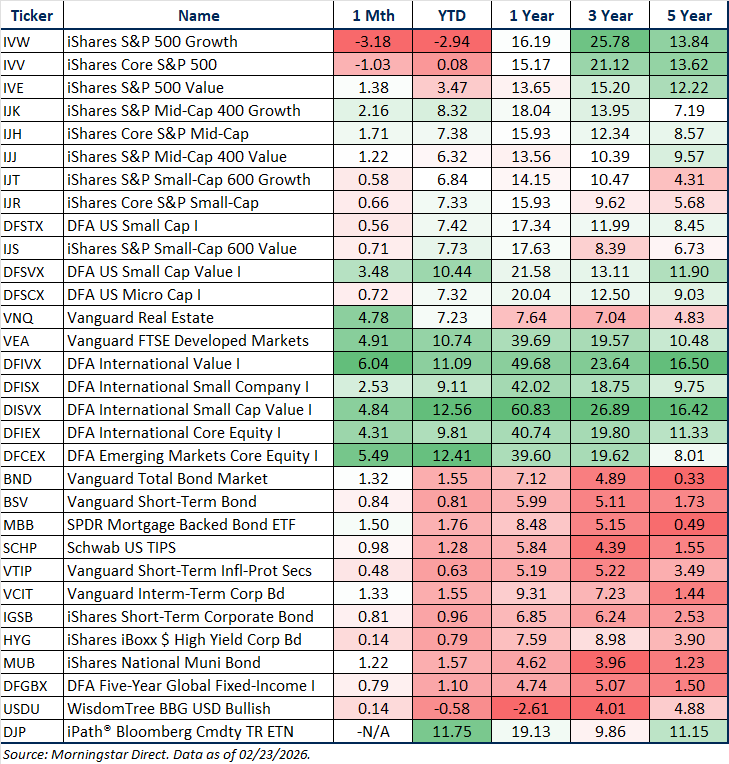
Fund Returns
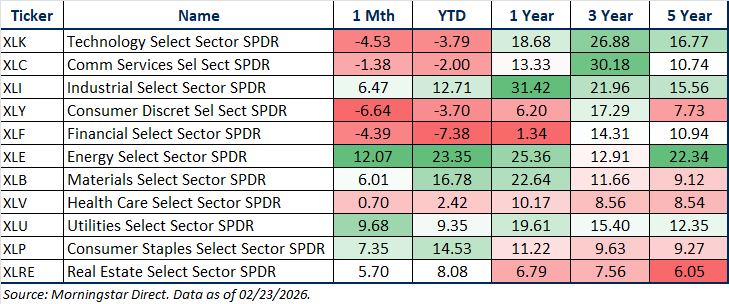
Sector Returns
Factor Returns
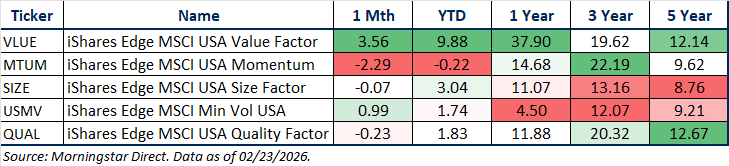
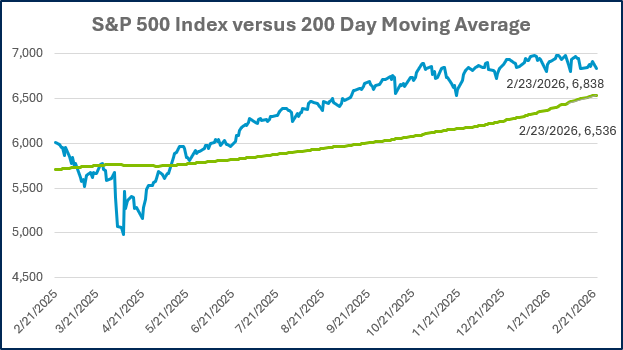
Source: Morningstar Direct.
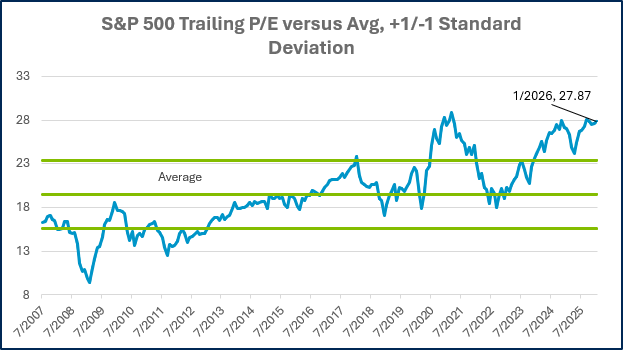
Source: Morningstar Direct.
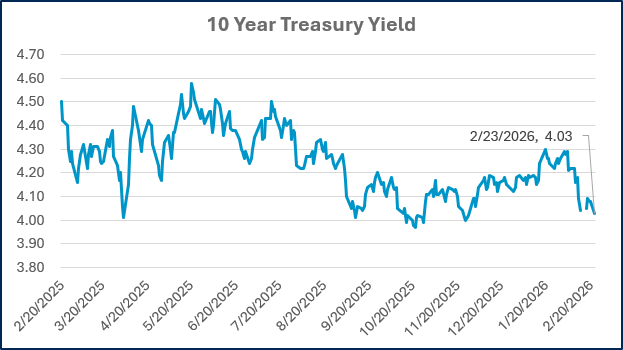
Source: Treasury.gov
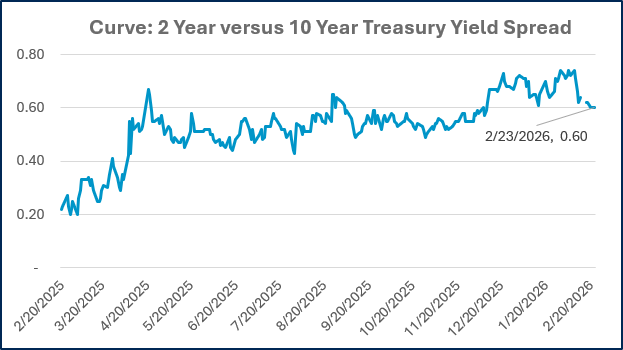
Source: Treasury.gov
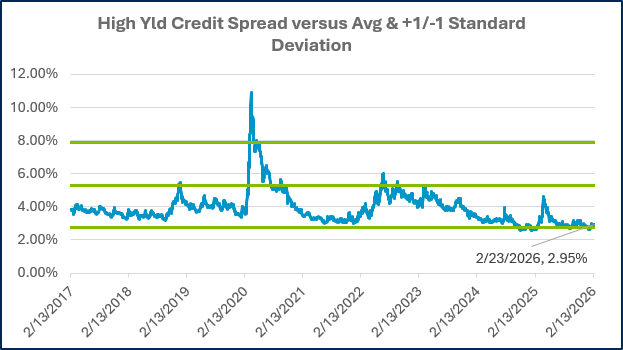
Source: FRED Database & ICE Benchmark Administration Limited (IBA)
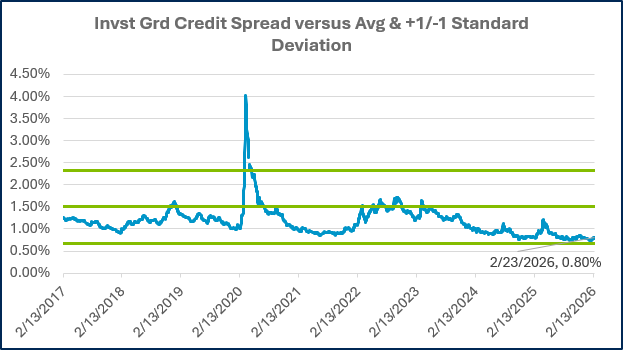
Source: FRED Database & ICE Benchmark Administration Limited (IBA)
Economic Calendar
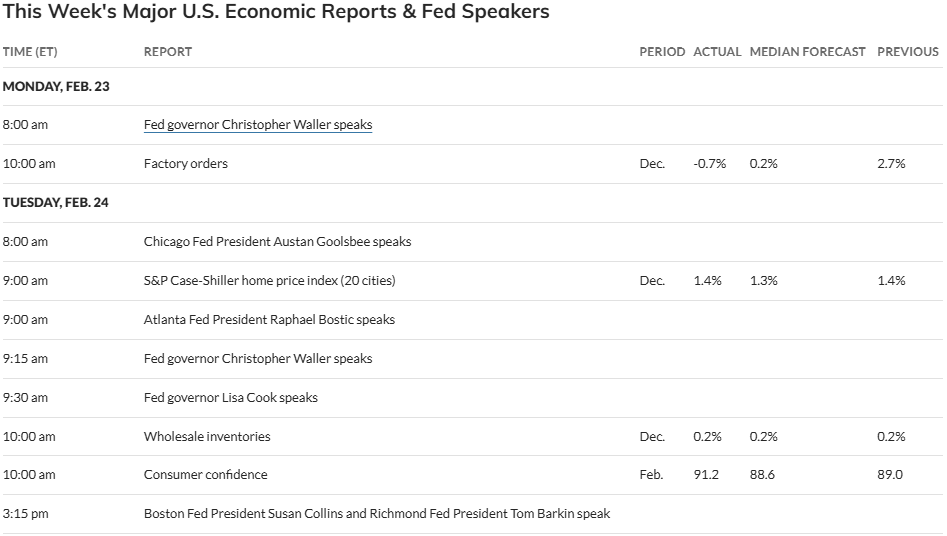
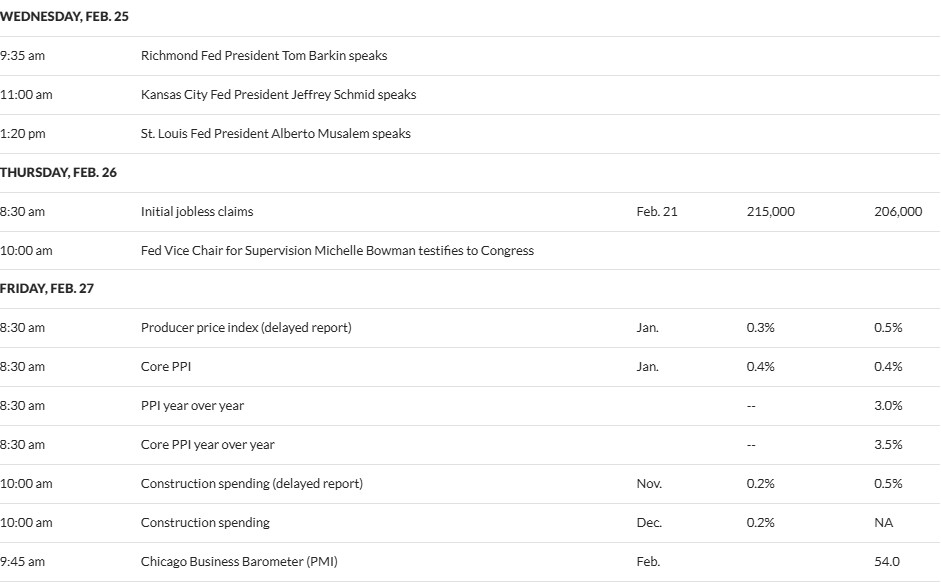
Source: MarketWatch

- Competition, Achiever, Relator, Analytical, Ideation
Josh Jenkins, CFA
Chief Investment Officer, Principal
Josh Jenkins, Chief Investment Officer, began his career in 2010. With a background in investment analysis and portfolio management from his previous roles, he quickly advanced to his current leadership position. As a member of the Lutz Financial Board and Chair of the Investment Committee, he guides Lutz Financial’s investment strategy and helps to manage day-to-day operations.
Leading the investment team, Josh directs research initiatives, while overseeing asset allocation, fund selection, portfolio management, and trading. He authors the weekly Financial Market Update, providing clients with timely insights on market conditions and economic trends. Josh values the analytical nature of his work and the opportunity to collaborate with talented colleagues while continuously expanding his knowledge of the financial markets.
At Lutz, Josh exemplifies the firm’s commitment to maintaining discipline and helping clients navigate market uncertainties with confidence. While staying true to the systematic investment process, he works to keep clients' long-term financial goals at the center of his decision-making.
Josh lives in Omaha, NE. Outside the office, he likes to stay active, travel, and play golf.
Recent News & Insights

Ag
Nebraska Tax Incentives for Ag Businesses
Nebraska offers tax incentives to various business types, including ag companies. This guide ...

Cybersecurity
Steps to Build a Strong IT Security Culture
Every organization relies on technology to operate, communicate, and serve customers. But even ...

QuickBooks
QuickBooks Online: Time, Billing, & Sales Forms
For many business owners, the work doesn’t end when the job is complete. Employee hours need ...

Market Commentary
The Market Is Harder to Outsmart Than It Looks
If you are looking for a reason to make a change to your portfolio, today’s market provides ...


Let’s get you where you want to go.
We work to simplify complexities, help make critical business decisions, and confidently focus on the things that are truly important to you. We embrace your business as our own to spark the right solutions and help you thrive.